- Oct 23, 2025
Out of the Cloud: How to Keep Your Business Running When AWS/Azure/Google Goes Down
- The Business Navigator
- 0 comments
On October 20, 2025, a significant outage at AWS sent ripples through the digital world. While headlines focused on big enterprises, the real impact was often felt by the small businesses that lean heavily on cloud-based tools and services to operate day-to-day.
What happens when your website, your payment processor, your file sharing or your chat bot goes offline for hours (or longer)? If you’re like many small businesses, you’re probably running lean. That means every hour of downtime = lost opportunity, frustrated customers, and revenue slipping through the cracks.
At Tempest Risk Management we believe resiliency and business-continuity planning aren’t just for big firms — they’re mission-critical for small businesses too. Here’s why:
Many small businesses live in the cloud — which is great, until it isn’t
Modern small businesses use powerful tools that simply weren’t available a decade ago: think Canva, Moxie, OneDrive, Squarespace, ChatGPT, Stripe, QuickBooks. Our team at Tempest uses many of these tools. They help us collaborate, create, process payments, manage files, serve customers and keep the business moving. But they also introduce a dependency: if any one of them goes down — even if you haven’t done anything wrong — you still feel the impact. The 10/20/2025 AWS outage reminded us: not just the giants can get knocked off, but the ecosystem that small businesses rely on can falter. When your tool fails, your workflow stops, customers have to wait, invoices don’t get sent, and yes — revenue is delayed or lost.
Delays amplify business risk
Downtime often comes with hidden costs that go beyond an immediate “system back up” moment:
Clients waiting on deliverables; your team idle.
Payments delayed or interrupted (e.g., if Stripe or similar goes down).
File sharing slows, collaboration halts.
Marketing and sales activities stall (if your website or email automation is tied to a service).
Reputation damage: if you can’t serve your client when they expect, your credibility takes a hit. For a small business, one “unexpected outage” — even for a few hours — can cascade quickly into lots of lost value.
Resiliency is not about avoiding risk completely — it’s about preparing for disruption
Here’s where many small business owners fall into a trap: they assume “it won’t happen to me,” or they rely solely on the vendor’s SLA. But at Tempest we advise: assume something will go wrong — and build your business so you’re ready.
That means:
Having redundancies: alternate tools, backup processes.
Having manual workarounds: if your primary tool fails, what can you fall back on?
Having communication plans: if you face a tool outage, how do you notify customers/internal teams and keep them informed?
Having data backups: your files, your customer records, your billing history — not just in one cloud tool, but in a separate safe place.
Having scenario thinking: What if it’s not just one tool — what if the cloud provider has a region-wide failure? What if your internet is down? What if your vendor stops supporting a tool you rely on?
The October 2025 AWS outage: a small business wake-up call
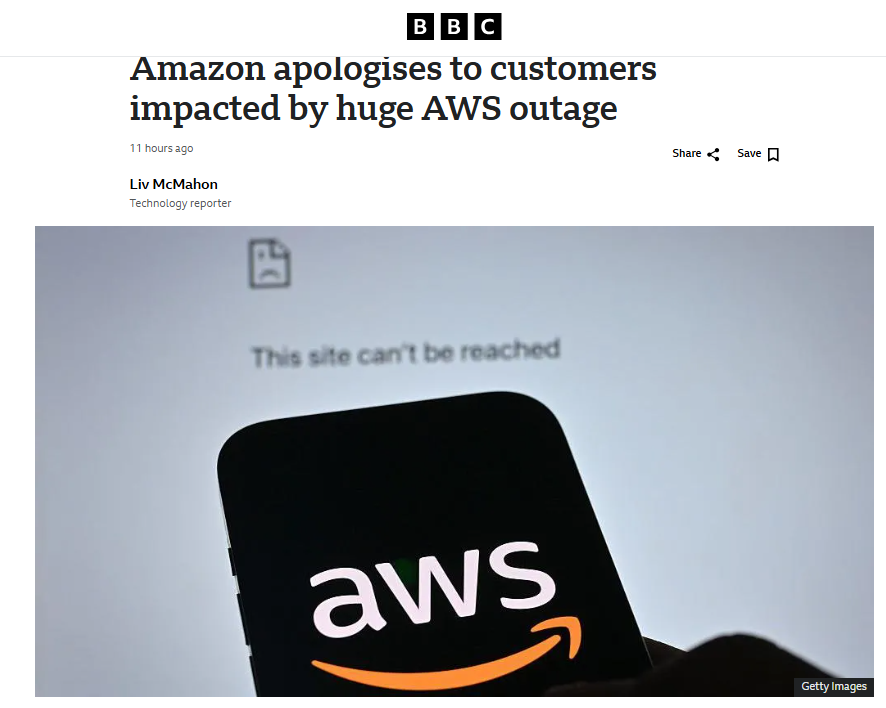
When AWS went dark on October 20, 2025, it didn’t just take down big-name apps — it exposed how dependent millions of small businesses have become on invisible cloud infrastructure.
While the headlines focused on large-scale disruptions at enterprise firms, the real story unfolded behind the scenes: independent designers couldn’t access Canva, bookkeepers couldn’t log into QuickBooks Online, and freelancers on project platforms watched their tools freeze mid-workday. In short, the digital gears that keep small business operations running ground to a halt.
As TechCrunch reported, “Thousands of small and midsize businesses relying on AWS-backed services experienced hours of downtime, payment delays, and customer communication gaps — highlighting how even a minor cloud hiccup can ripple across the small-business economy.” (TechCrunch, October 21, 2025)
Similarly, The Verge noted, “For small organizations, the AWS outage underscored an uncomfortable truth: you may not be an AWS customer directly, but your favorite SaaS tools almost certainly are.” (The Verge, October 22, 2025)
Here’s the bottom line: Amazon isn’t going to save your files or your revenue. You’re one of millions of customers, and their focus will always be on restoring global systems — not your individual workflow.
That’s why resilience has to start with you. Whether you’re a solopreneur, freelancer, or small-business owner, your continuity plan can’t rely on a single vendor. You may not host your own infrastructure on AWS, but the tools you depend on — Canva, Moxie, OneDrive, Squarespace, ChatGPT, Stripe, QuickBooks — all tie back to it. When the cloud shakes, your business feels it..
Business continuity isn’t optional — it’s foundational
In one of our previous articles at Tempest, we highlight that one of the non-negotiables for any business is a business continuity plan. A continuity plan doesn’t need to be massive, but it does need to answer basic questions: If a key system fails, what do we do? If our payments processor is offline, how do we still serve customers? If our website is inaccessible, how do we communicate?
For small businesses, planning this ahead ensures you don’t scramble when disruption occurs, you respond instead.
Learn more at https://www.tempestrisk.com/business-continuity
Practical steps you can take now
Here are action items you can apply immediately to boost your resilience:
List your critical tools. Make a short inventory of the tools your business can’t operate without (e.g., Canva for design, Stripe for payments, QuickBooks for accounting).
Assess failure impact. For each tool ask: What happens if it’s unavailable for an hour? A day? A week? What would the revenue, client satisfaction, or project timeline impact be?
Identify alternative solutions or manual processes.
Back up your data. Don’t keep everything only “in the cloud” with no local fallback. Maintain offline copies or mirrored backups.
Document workarounds. Write short SOPs (standard operating procedures) for “tool X is down” so that staff know what to do without delay.
Communicate with clients. Let them know you have contingency plans (this builds trust), and if an outage occurs, proactively update them.
Engage expert help if needed. If continuity feels overwhelming, consider the team at Tempest. We help small businesses build risk-aware operational frameworks so they’re prepared, not surprised.
A resilient business is a confident business
When you build redundancy, plan for disruption, and keep your operations flexible, you gain something valuable: confidence. You’re not just reacting when things go wrong — you’re operating from a position of strength. That means when the next cloud outage hits (and yes — there will be another one), you’re not frozen. You are ready to pivot, communicate, work around, and keep your business moving forward.
Final thoughts
The October AWS outage is more than a headline. For many small businesses, it was a moment of exposure — of how fragile some operations can be when dependencies stack up and continuity is unplanned. Don’t wait for the next disruption to hit your business. Use this moment as a catalyst. Build your backup plan. Embed resiliency into the fabric of your business operations. The tools, the workflows, the human element — all deserve it. And remember: you don’t have to build it alone. If you’re looking for guidance, templates, or a clear operational roadmap — the team at Tempest Risk Management is here to help you build your plan and weather whatever comes next.
Let’s build a business that doesn’t just survive uncertainty — but thrives through it.

Andy Ziegler is founder and CEO of Tempest Risk Management, The Tempest Business Navigator and AIndy.
Sign up to get more FREEBIES!
Sign up to be notified when we have promotions, new resources, webinar and training announcements and more!