- Sep 9, 2025
AI Adoption Framework Pillar 1: Assessment and Implementation
- Business Navigator
- 0 comments
Artificial Intelligence (AI) is no longer an emerging trend—it’s a present reality. From small businesses to global corporations, from classrooms to city governments, organizations of every kind are exploring how AI can improve performance, reduce costs, and drive innovation. But with such powerful technology comes significant responsibility.
At Tempest, we believe that successful AI adoption requires a structured, intentional process. Done right, AI can transform your organization. Done wrong, it can introduce risks, erode trust, and waste resources. That’s why AI Adoption and Implementation is the first pillar in our Three-Level AI Adoption Framework—and why it must be developed in parallel with the other two pillars: AI Cyber Defense and AI Ethics & Compliance.
This article provides leaders with a practical roadmap for adopting AI responsibly, sustainably, and effectively.
Why AI Adoption Needs a Framework
Too often, organizations rush to “try AI” without a plan—buying tools, experimenting in silos, or giving staff free rein. The result? Fragmentation, wasted time, and vulnerabilities. A structured adoption process helps you:
Identify where AI creates real value
Avoid unnecessary investment in “shiny object” tools
Ensure staff are trained and processes are updated
Maintain trust with customers, students, employees, or citizens
Integrate security and ethics from day one
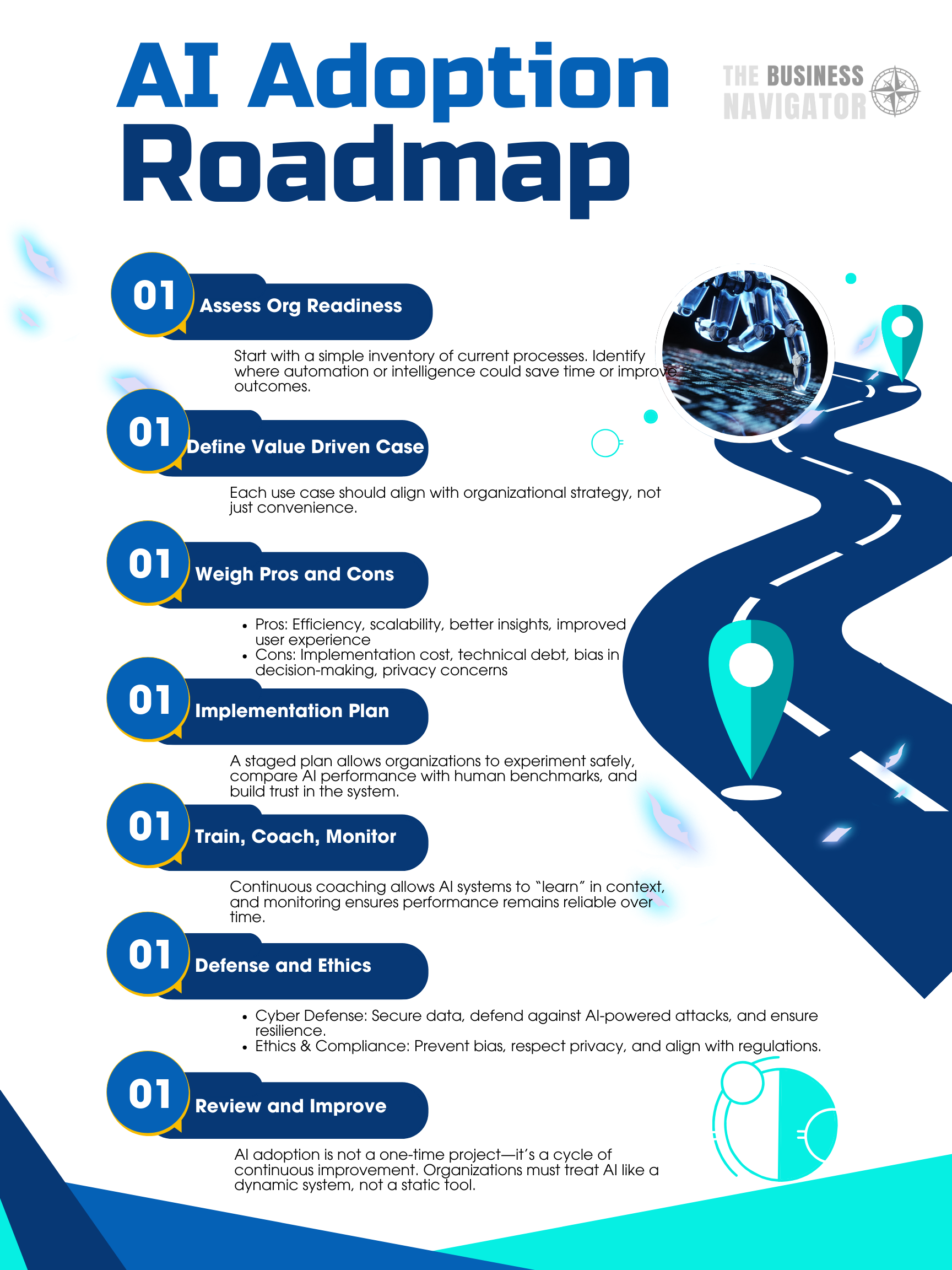
The AI Adoption Roadmap: Step by Step
1. Assess Organizational Readiness
Before AI can be adopted, leaders must understand their organization’s current state. Jumping ahead without assessing readiness often leads to failed pilots or expensive mistakes. This stage is about asking hard questions: Do we have the right infrastructure? Are our processes stable enough to automate? Is our workforce prepared for this change? Without this baseline, every subsequent step risks being built on shaky ground.
What are the most pressing challenges or inefficiencies?
Do you have the data, infrastructure, and skills to support AI?
Are staff open to change—or fearful of it?
What risks must be managed (e.g., reputational, operational, legal)?
Pro Tip: Start with a simple inventory of current processes. Identify where automation or intelligence could save time or improve outcomes.
2. Define Value-Driven Use Cases
The temptation to adopt AI everywhere is strong, but unfocused efforts lead to wasted resources. Organizations should carefully target AI use cases where the technology can create measurable value. This is less about replacing people and more about empowering them—AI should free up time for higher-value work while improving service quality and outcomes. Aligning AI projects to core organizational goals ensures the technology enhances mission delivery rather than distracting from it.
Businesses: AI chatbots for customer support, predictive analytics for sales
Schools: Personalized learning platforms, administrative automation
Nonprofits: Donor engagement tools, grant writing support
Government: Streamlined permitting, fraud detection, resource planning
Each use case should align with organizational strategy, not just convenience.
3. Weigh the Pros and Cons
No AI solution is without trade-offs. Leaders must carefully evaluate potential benefits against the risks and costs. This step prevents overenthusiasm from overshadowing potential downsides, such as bias, compliance issues, or hidden costs of integration. A balanced approach ensures leadership understands the full picture before committing, and gives employees confidence that adoption is thoughtful, not reckless.
Pros: Efficiency, scalability, better insights, improved user experience
Cons: Implementation cost, technical debt, bias in decision-making, privacy concerns
This assessment should include voices from leadership, IT, compliance, frontline staff, and stakeholders.
4. Develop a Staged Implementation Plan
AI adoption is best approached as an evolution, not a revolution. Moving too fast can overwhelm staff and increase the risk of errors. A staged plan allows organizations to experiment safely, compare AI performance with human benchmarks, and build trust in the system. Running AI alongside existing processes during early phases is essential—this “parallel operations” approach ensures humans are still in control while AI learns and improves.
Pilot Phase – Select one or two low-risk use cases.
Parallel Operations – Run AI alongside human processes. Staff monitor, coach, and refine AI performance.
Controlled Autonomy – Permit AI to handle certain tasks independently, with regular oversight.
Scaling – Expand AI use cases based on lessons learned and documented outcomes.
5. Train, Coach, and Monitor
Even the most advanced AI is not a “set it and forget it” technology. For adoption to succeed, people must be trained to work alongside AI systems. This means both teaching staff to use AI tools effectively and empowering them to correct errors or biases. Continuous coaching allows AI systems to “learn” in context, and monitoring ensures performance remains reliable over time. A workforce that feels prepared and supported is far more likely to embrace AI instead of resisting it.
Teach employees how to spot errors or bias in AI outputs.
Encourage staff to view AI as a “partner,” not a threat.
Create ongoing feedback loops between AI performance and human oversight.
6. Integrate Cyber Defense and Ethics from Day One
AI adoption does not happen in a vacuum. Without cybersecurity protections, organizations may open new doors for attackers. Without ethical standards, AI decisions can unintentionally harm people or break trust. These safeguards cannot be “bolted on” after adoption—they must be designed in from the start. Every pilot, parallel process, and scaled implementation should meet established security and compliance standards before it goes live.
Cyber Defense: Secure data, defend against AI-powered attacks, and ensure resilience.
Ethics & Compliance: Prevent bias, respect privacy, and align with regulations.
Nothing should move from pilot to production until safeguards are in place.
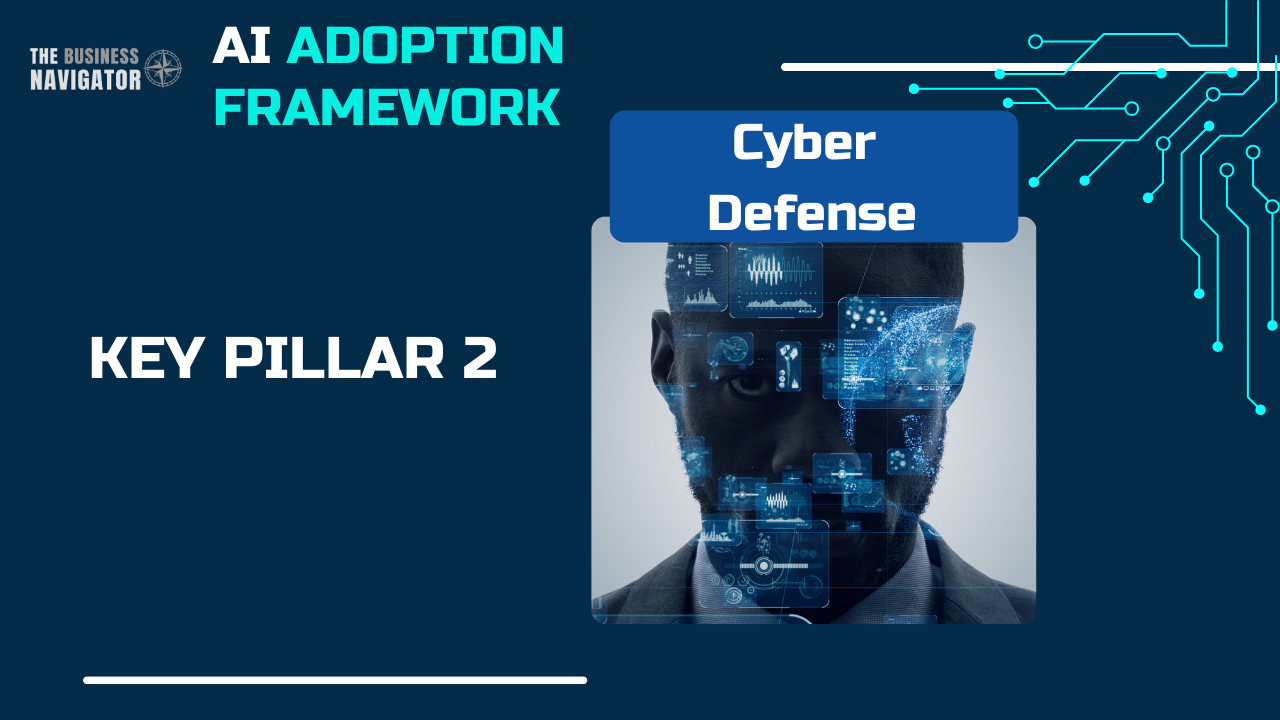
For a deep dive into Cyber Defense, make sure to check out the Tempest Business Navigator AI Adoption Framework Part 3: Cyber Defense.
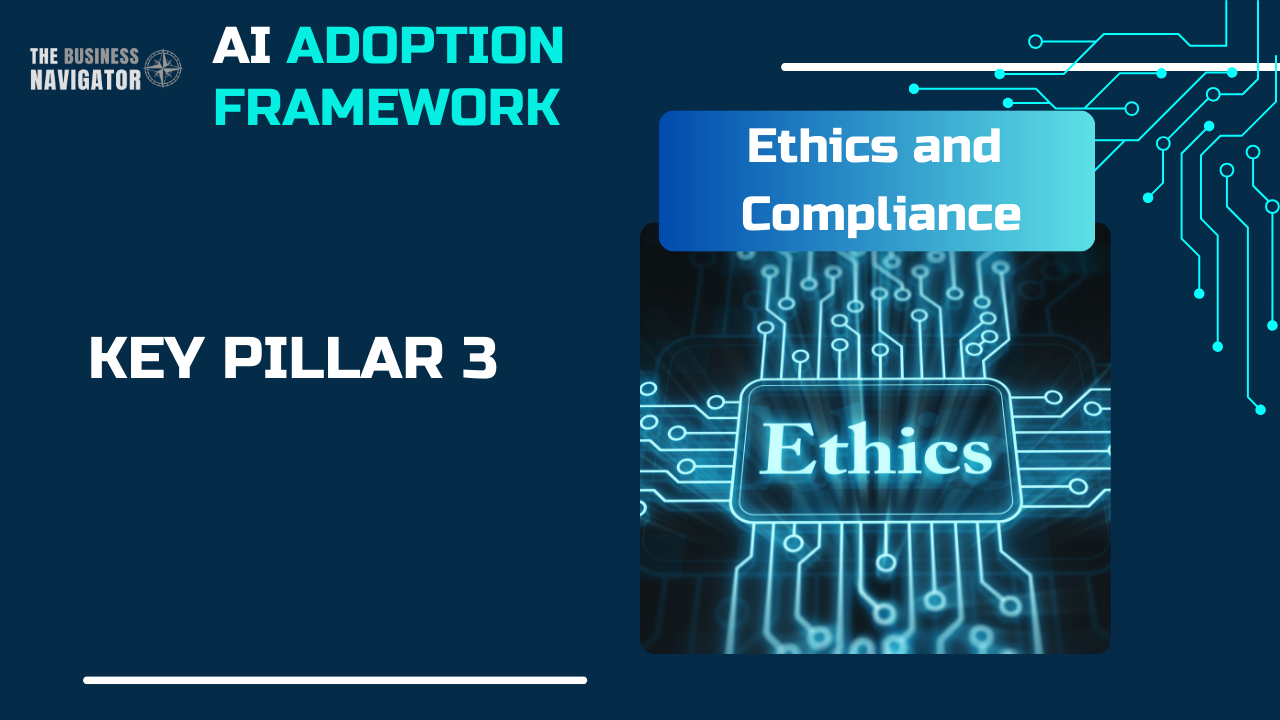
For a deep dive into Ethics and Compliance, make sure to check out the Tempest Business Navigator AI Adoption Framework Part 4: AI Ethics and Compliance which includes this AI Ethics and Compliance Policy free resource download.
7. Measure, Review, Improve
AI adoption is not a one-time project—it’s a cycle of continuous improvement. Organizations must treat AI like a dynamic system, not a static tool. This means defining clear metrics for success, reviewing AI’s performance regularly, and making adjustments as conditions change. Laws will evolve, cyber threats will advance, and AI models will shift. A culture of review and improvement ensures your organization stays ahead rather than playing catch-up.
Define metrics for success (cost savings, response times, improved outcomes).
Conduct quarterly reviews of AI systems.
Adjust policies, retrain staff, and update tools as regulations and threats evolve.
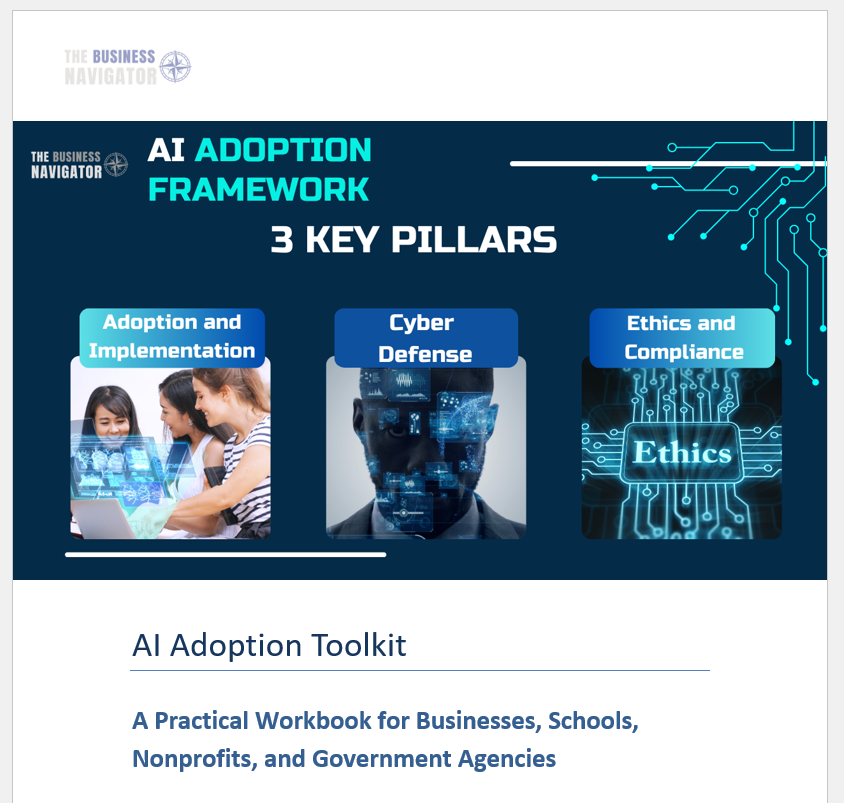
Download the 4 page AI Adoption Toolkit from for FREE by clicking here
Conclusion
AI adoption and implementation is not about buying software—it’s about transforming how your organization works. By following a careful, staged process, and by integrating cybersecurity and ethical safeguards from the start, organizations can unlock the true value of AI while protecting themselves from its risks.
This is the first pillar of the Tempest AI Adoption Framework. In upcoming articles, we’ll dive into the other two critical areas:
AI Cyber Defense – How to protect your organization from AI-powered threats
AI Ethics & Compliance – How to adopt AI responsibly, transparently, and lawfully
📌 Subscribe to the Tempest Business Navigator to receive the full series directly in your inbox and gain access to actionable resources that help you adopt AI safely, securely, and effectively.
Sign up to get more FREEBIES!
Sign up to be notified when we have promotions, new resources, webinar and training announcements and more!